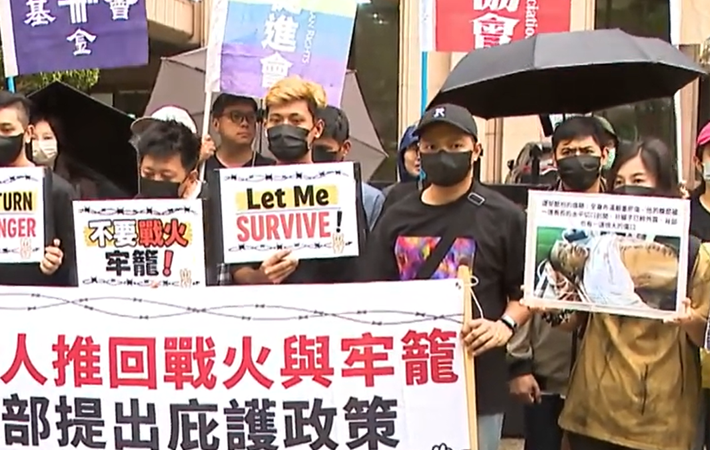
Download Taiwan: Committee makes recommendations to improve civic space while civil society protest efforts to deport Myanmar asylum seekers DATE POSTED: 16.07.2026 Civil society and Myanmar asylum seekers protest government deportation plans, May 2026 (Photo Credit: Formosa News) The state of civic space in Taiwan is rated as ‘open’ by the CIVICUS Monitor. This means the state has created an enabling environment for people to enjoy their civic freedoms. Civil society is able to operate and undertake their work without harassment or undue interference. People are free to hold protests in public places and form associations. There is also a relatively free media, and journalists are able to do their work without any major restrictions.In May 2026, an international review of Taiwan’s fourth national report on the implementation of the UN International Covenant on Civil and Political Rights as well as the International Covenant on Economic, Social and Cultural Rights was held. According to the Ministry of Justice, the five-day event involved experts, officials and representatives of civil organisations from home and abroad.The review committee made recommendations to revise laws that impact on freedom of expression and peaceful assembly. Civil society protested against efforts to deport Myanmar nationals. Multiple protests by citizens, environmental activists, migrant workers, civil society and political parties were held without any restrictions.ExpressionCommittee calls for review of laws that impact on expression International review of #Taiwan’s🇹🇼 4th national report on #UN🇺🇳 #humanrights covenants underway in #Taipeihttps://t.co/vr98HlMsVi pic.twitter.com/lh6ufcbtua— Taiwan Today (@Taiwan_Today) May 13, 2026 As part of its review of its fourth national report on the implementation of the UN International Covenant on Civil and Political Rights, concerns were raised related to freedom of expression.The committee said they were concerned about prosecutions under Article 63 of the Social Order Maintenance Act (“spreading rumours sufficient to affect public tranquillity”), noting that the provision “lacks the precision required by criminal law”. During the present Review, the Committee was pleased to learn that prosecutions under Article 63 have been declining in recent years and that the Executive Yuan has instructed the Ministry of Interior to reevaluate the provision, acknowledging its vagueness and its impact on freedom of expression.Nonetheless, there appears to be no timeline or clarity about the outcome of that ministerial review, including whether it will result in legislation to revise Article 63 in order to be consistent with international standards.At the same time, several provisions of the Criminal Code also use vague terms that fail to meet legality standards under international human rights law, including but not limited to Article 140 (insult of public officials), Articles 309 and 310 (defamation), and Article 104 (electoral disinformation). Article 64 of the Social Order Maintenance Act (incitement to public disorder) is problematic for the same reasons.While Taiwanese courts have sought to provide clarity as to the scope and application of some of these laws, the vagueness of key terms of these provisions renders them inconsistent with international standards and raises serious concerns about the chilling effects they likely have on lawful expression. The Committee recommends that the Government initiate a comprehensive review of the legal framework governing restrictions on expression related to national security, disinformation, public order and related topics with a view to bringing them into alignment with international human rights standards.AssociationCivil society protest efforts to deport Myanmar nationals Civil society groups are calling on the government to halt any deportation of Myanmar nationals back to their country.According to New Bloom, civil society activists held a press conference outside the Ministry of the Interior on 30th April 2026, protesting the ministry’s role in attempting to push Myanmar asylum seekers out of Taiwan. Among the groups involved in the press conference were the Asia Citizen Future Association, Taiwan Association for Human Rights, Taiwan Gongsheng Youth, Taiwan Labor Front, Taiwan International Workers’ Association, and Taiwan Alliance for Myanmar.Taiwan currently does not have any asylum laws. At the start of the civil war in Myanmar, more than five years ago, the Taiwanese government originally promised not to deport Myanmar nationals back under the provisions of a temporary residency status. However, several years later, the actual of issuing of such documents has yet to happen. Occurring as a project under the National Immigration Agency of the Ministry of the Interior in 2023, after fifty applications, none have been approved. Myanmar nationals stranded in Taiwan have no work permits. As such, this has pushed many of those currently in Taiwan to work illegally to survive.The press conference opened with the organisers highlighting the brutal torture faced by Burmese at the hands of the military government.Civil society groups consequently demanded that the Ministry of the Interior stop pressuring Burmese in Taiwan to leave, develop a residency policy for those who should not be repatriated to Myanmar under international law, and grant temporary residency to those awaiting asylum decisions.Peaceful AssemblyCommittee calls for amendments to law on peaceful assemblyAs noted above, Taiwan undertook a review of its fourth national report on the implementation of the UN International Covenant on Civil and Political Rights.In the Concluding Observations and Recommendations adopted by the International Review Committee Taipei on 15th May 2026, it noted that Taiwan has adopted an Assembly and Parade Act that implements the right of peaceful assembly. However, the Committee is concerned that some of the regulations concerning the location of peaceful assemblies, particularly those applicable to “prohibited zones” and “security distances,” may limit peaceful assembly in ways that run counter to obligations under Article 21 of the ICCPR and interpretations of its requirements, especially General Comment 37 of the Human Rights Committee.The Review Committee recommended that the Government evaluate such restrictions and consult with civil society in order to determine what restrictions are necessary while not undermining the full exercise of the right of peaceful assembly. In addition, the Committee recommends the replacement of the authorisation system with one of notification.The Taiwan Association for Human Rights (TAHR) called on the government not to ignore the experts’ advice and to immediately comply with the experts’ advice to amend the law.Multiple protests and gatherings held by citizens, activists and political partiesIn recent months, multiple protests by citizens, environmental activists, migrant workers, civil society and political parties were documented in Taiwan without any restrictions. On 26th March 2026, protesters from the anti-nuclear group No Nukes Action Platform gathered outside the Executive Yuan, voicing opposition to the government’s potential plan to reopen the Kuosheng and Maanshan Nuclear Power Plants. The protest was supported by Green Citizen’s Action Alliance, Citizens of the Earth, Environmental Jurist Association, and Homemakers United Foundation The groups raised concerns about the government’s handling of nuclear energy, demanding updates to evacuation plans in case of a nuclear disaster, greater transparency on the societal costs of nuclear power, and a discussion on the long-term disposal of nuclear waste. Another protest was also held in May 2026.Thousands of people gathered in front of the Presidential Office in Taipei on 29th March 2026 to protest the guilty verdict and 17-year prison sentence handed to former Taiwan People’s Party (TPP) chairman Ko Wen-je, with speakers accusing the judiciary of political bias and abuse of power. Ko, who finished third in Taiwan’s 2024 presidential election, was convicted by the Taipei District Court of bribery and other corruption-related offences in connection with a real estate development project and three other cases.In April 2026, civil society groups demonstrated outside the ruling Democratic Progressive Party (DPP) headquarters in protest against the Lai administration’s failure to live up to campaign promises to build social housing. In particular, civil society groups criticised the Lai administration for promising to build 130,000 social housing units during elections, then quietly revising this down to 40,000 units. At the demonstration, civil society groups called on the DPP to provide affordable housing, rather than only rental subsidies.On 23rd May 2026, thousands demonstrated against the opposition Chinese Nationalist Party (KMT) cuts to defence spending, which reduced spending from 1.25 trillion NT (USD 38.8 million) to 780 billion NT (USD 24.2 million). The main organiser of the demonstration was the Economic Democracy Union, the politically progressive social movement organisation that played a key role in the 2014 Sunflower Movement and 2024 Bluebird Movement. The protest began at the SOGO outside the Zhongxiao Fuxing MRT and progressed eastward through the city. The march finished outside the Bank of China building in Xinyi. The building is often used to represent China, in the absence of any Chinese government building present in Taiwan. “Ahead of Tiananmen Anniversary, Protest Held to Call for Release of Hong Kong Activists” by @brianhioe https://t.co/Znb6TMQ21s— New Bloom Magazine (@newbloommag) June 3, 2026 Civil society groups gathered on 1st June 2026 outside Taipei’s Ximending shopping district calling for the release of Hong Kong activists Lee Cheuk-yan and Chow Hang-tung. Lee and Chow were the chair and vice chair respectively of the Hong Kong Alliance in Support of Patriotic Democratic Movements of China. The group was the primary organiser of the rallies held annually in Victoria Park to commemorate the anniversary of the Tiananmen Square Massacre each year on 4th June. The two have been in pre-trial detention since September 2021. The demonstration in Ximen was held ahead of the anniversary of the Tiananmen Square Massacre.On 14th June 2026, about 100 migrant workers and members of rights groups held a protest in front of the Ministry of Health and Welfare (MOHW) in Taipei, calling for migrant domestic workers’ inclusion in the nation’s official long-term care workforce. Serikat Buruh Industri Perawatan Taiwan representative Napia said that domestic migrant caregivers live with their care recipients and provide 24-hour daily care, but face unclear working hours, difficulties in taking time off, interrupted rest periods and obstacles to their right to health. Caregiving is a profession that deserves protection, and caregivers demand equal legal protection, humane working hours and the right to reasonable rest, she said. Civic Space Developments Country Taiwan Country rating Open Category Latest Developments Tags bureaucratic restriction, environmental rights, labour rights, protest, refugees and migrants, Date Posted 16.07.2026 Back to civic space developments
المادة المؤرشفة
النص الكامل محفوظ هنا كما التقطه الأرشيف من المصدر.

Download Taiwan: Committee makes recommendations to improve civic space while civil society protest efforts to deport Myanmar asylum seekers DATE POSTED: 16.07.2026 Civil society and Myanmar asylum seekers protest government deportation plans, May 2026 (Photo Credit: Formosa News) The state of civic space in Taiwan is…
- عدد الكلمات
- 1٬666
- زمن قراءة تقديري
- 9 دقيقة
- صور محفوظة
- 2
النص المؤرشف 11٬332
الصور المحفوظة
نسخ يحتفظ بها الأرشيف على خوادمه. كل صورة تحمل الرابط الذي التُقطت منه، ويظل معروضًا حتى لو توقف عن الاستجابة.
-
civicusmonitor.contentfiles.net
-
civicusmonitor.contentfiles.net
لماذا هذه الدرجة؟
كل سطر مؤشر طابقته المنظومة حرفيًا في النص، بوزنه المعلن مسبقًا في قاموس الموضوعات.
priority = 68 (topics) + 12 (bonuses) = 80 · risk = min(100, 80 x 4 + 8) = 66
-
+12
خطر ترحيل/إبعاد deportation
…ekers DATE POSTED: 16.07.2026 Civil society and Myanmar asylum seekers protest government deportation plans, May 2026 (Photo Credit: Formosa News) The state of civic space in Taiwan is… Downl…
-
+10
تعذيب torture
…egally to survive.The press conference opened with the organisers highlighting the brutal torture faced by Burmese at the hands of the military government.Civil society groups consequentl…
-
+8
لاجئون refugee
…Developments Tags bureaucratic restriction, environmental rights, labour rights, protest, refugees and migrants, Date Posted 16.07.2026 Back to civic space developments
-
+8
أوضاع السجون prison
…residential Office in Taipei on 29th March 2026 to protest the guilty verdict and 17-year prison sentence handed to former Taiwan People's Party (TPP) chairman Ko Wen-je, with speakers a…
-
+8
حرية التعبير freedom of expression
…m home and abroad.The review committee made recommendations to revise laws that impact on freedom of expression and peaceful assembly. Civil society protested against efforts to deport Myanmar national…
-
+8
حرية الصحافة journalist
…otests in public places and form associations. There is also a relatively free media, and journalists are able to do their work without any major restrictions.In May 2026, an international r…
-
+7
الحق في الصحة health
…0 migrant workers and members of rights groups held a protest in front of the Ministry of Health and Welfare (MOHW) in Taipei, calling for migrant domestic workers’ inclusion in the nati…
-
+7
حقوق المهاجرين migrant
…orts to deport Myanmar nationals. Multiple protests by citizens, environmental activists, migrant workers, civil society and political parties were held without any restrictions.Expressio…
-
+6
حقوق العمل labor
…n Future Association, Taiwan Association for Human Rights, Taiwan Gongsheng Youth, Taiwan Labor Front, Taiwan International Workers’ Association, and Taiwan Alliance for Myanmar.Taiwan …
-
+6
الحق في السكن housing
… against the Lai administration’s failure to live up to campaign promises to build social housing. In particular, civil society groups criticised the Lai administration for promising to b…
الموضوعات الحقوقية بأوزانها
الوزن هو نقاط الموضوع في قاموس التصنيف، وهو ما يُبنى عليه مجموع الأولوية.
- تعذيب torture 10
- حرية التعبير freedom of expression 8
- حرية الصحافة journalist 8
- أوضاع السجون prison 8
- لاجئون refugee 8
- حقوق المهاجرين migrant 7
- الحق في الصحة health 7
- حقوق العمل labor 6
- الحق في السكن housing 6
كيانات المادة داخل الأرشيف
الرقم بجانب كل كيان هو عدد المواد التي ورد فيها داخل الأرشيف كله.
منظمات 11
أشخاص 12
شبكة العلاقات
لا توجد مواد مطابقة بعد؛ هذه كيانات المادة كما استخرجتها المنظومة.
- مادة
- منظمة
- شخص
العلاقات نفسها كقائمة
الكيانات المستخرجة
- Bluebird Movement منظمة
- Economic Democracy Union منظمة
- Homemakers United Foundation منظمة
- Human Rights Committee منظمة
- International Review Committee منظمة
- National Immigration Agency منظمة
- National Immigration Agency of the Ministry منظمة
- Review Committee منظمة
- Sunflower Movement منظمة
- Taipei District Court منظمة
- Taiwan Labor Front منظمة
- Action Alliance شخص
و12 من أصل 23 كيانًا. الرسم يقتصر على أقوى العلاقات كي يبقى مقروءًا.